Cleat setup
€40 30 minutes
The most important contact point: foot, cleat, pedal.
- Per pair of shoes
- Cleat fore-aft position, rotation and angle
- 10% off each additional pair
Included in the full bike fit for one pair of shoes.
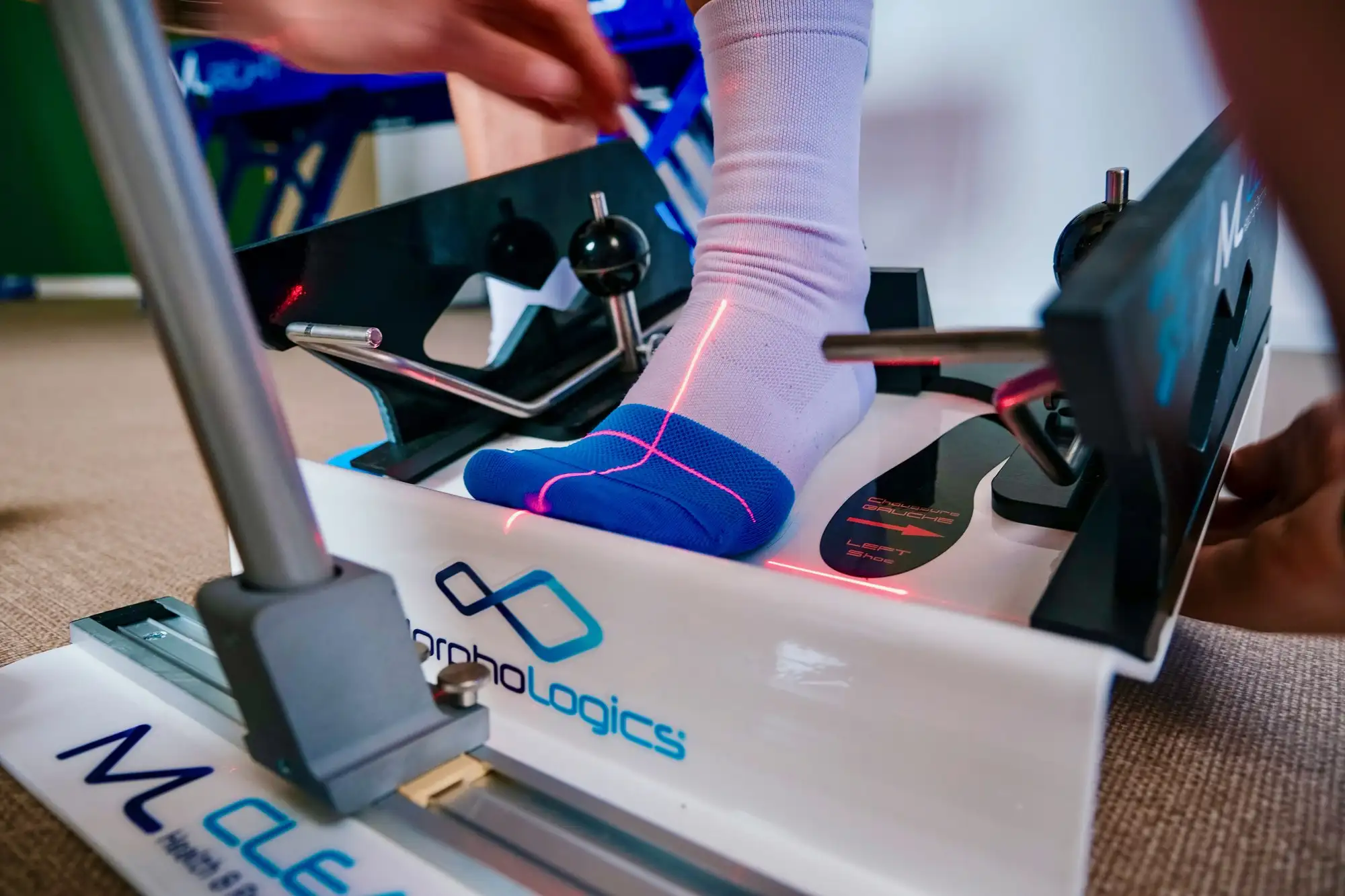
The most neglected contact point on the bike. A few degrees of rotation or a few millimetres fore-aft are enough to install knee pain. Here are the three parameters, the pains they cause, and why your two cleats should not be set the same.
By Gaspard Blanc, osteopath (D.O.) and bike fitter · Updated 25 October 2026
The cleat’s position front to back. Starting point: the pedal axle under the head of the first metatarsal. The further back the cleat, the more the calf is relieved and the more stable the foot, at the cost of a little liveliness. Long distance, triathlon, sensitive calves or Achilles tendons: move it back.
The cleat’s angle, which decides how the foot points on the pedal. It must follow your foot’s natural rotation, the one you have when walking or sitting with legs hanging, not a “straight” position imposed on it. A foot forced into line is a knee that twists with every pedal stroke.
The distance between the two feet. It depends on the width of your pelvis and how your knees track. It is adjusted by shifting the cleat towards the inside or outside of the shoe and, if that is not enough, with spacers on the pedal axle or long-axle pedals.
The detailed method, system by system (Shimano SPD-SL, Look Keo, Speedplay, SPD), is in the FramIQ cleat guide, with a free module that works out the rotation from a photo of your feet.
| What you feel | Likely cause | What I would do |
|---|---|---|
| Pain on the outside of the knee, IT band syndrome | Cleat rotated too far inwards, Q-factor too narrow | Open the rotation, move the cleat towards the inside of the shoe |
| Pain on the inside of the knee | Cleat rotated too far outwards, Q-factor too wide | Close the rotation, bring the cleat in |
| Burning or numbness under the forefoot | Cleat too far forward, shoe too tight, unsuitable insole | Move the cleat back 5 mm, loosen, supportive insole |
| Achilles tendon or calf pain | Cleat too far forward, saddle too high | Move the cleat back, check saddle height |
| Knee drifting inwards on the downstroke | Foot collapsing inwards, weak hip | Corrective wedge or insole, hip work |
| Heel hitting the crank, shoe rubbing | Q-factor too narrow for your pelvis width | Move the cleat out, or pedal axle spacers |
| Pain on one side with no obvious reason | Asymmetry of rotation, length or pelvis | Measure each foot, set left and right differently |
Cleats are never the only culprit: a saddle that is too high gives the same calf pain, a stiff hip the same knee drifting inwards. Hence the point of examining before adjusting.
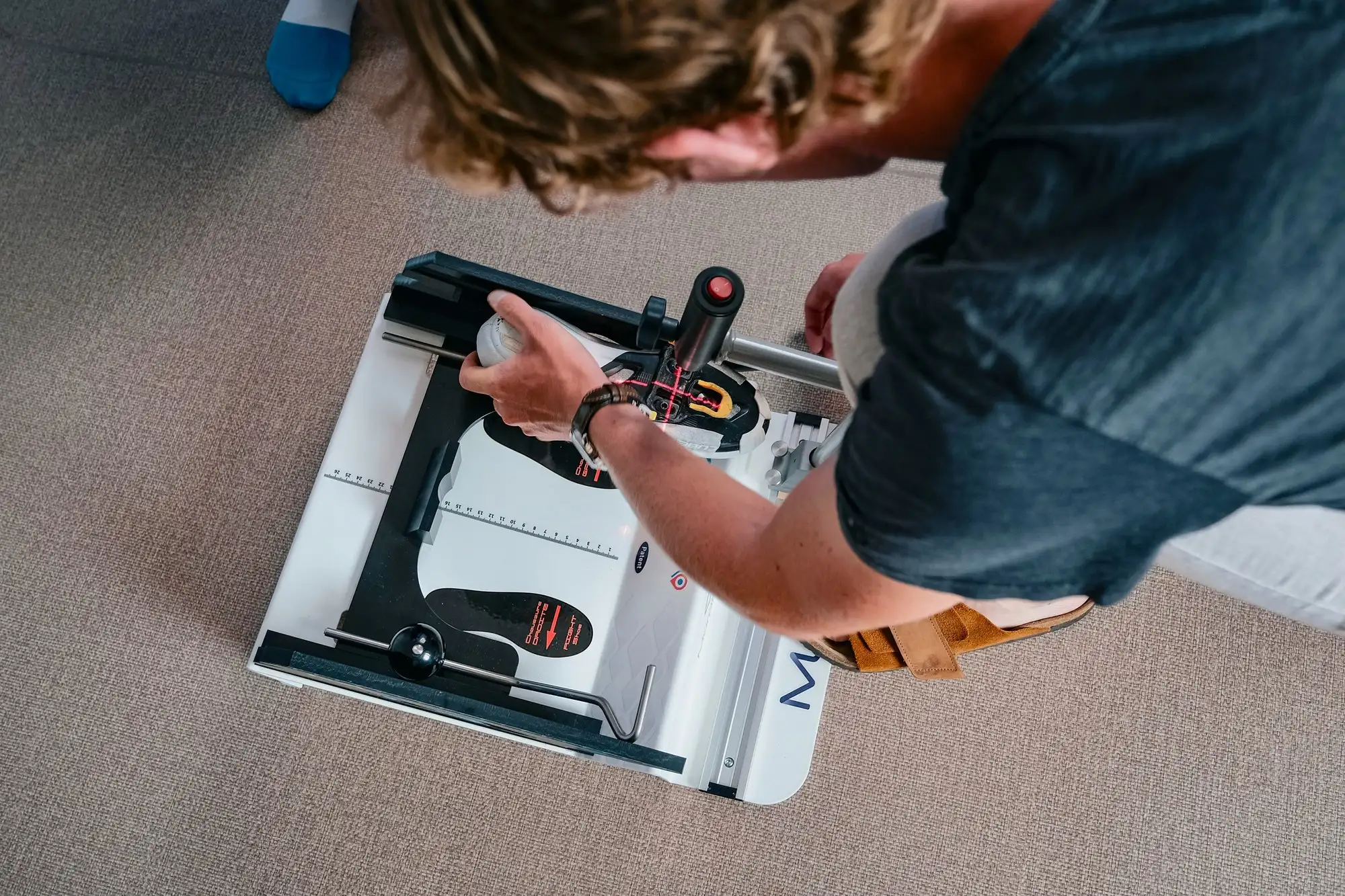
At the practice, I measure each foot’s natural rotation, each ankle’s mobility and each leg’s length before touching the cleats. In most cases the final setting differs left and right, by a few degrees or a few millimetres. It is the opposite of a “middle” setting applied to both shoes.
And when the foot is not the cause, I say so: a knee drifting inwards often comes from a hip that does not stabilise, and no cleat rotation will correct that. Then we treat the hip, and adjust afterwards.
Once the cleats are set, I mark your reference points on the shoes and write them in your report, so you can refit them yourself after changing shoes or cleats.
€40 30 minutes
The most important contact point: foot, cleat, pedal.
Included in the full bike fit for one pair of shoes.
The full bike fit includes cleat setup for one pair of shoes, along with the rest of the position: saddle, handlebar, stem. Second pair: 10% off.
Coming for cleats only: bring your shoes, your pedals fitted on the bike, and your old cleats if you are changing them. 30 minutes is enough.
See the full bike fitStarting point: the pedal axle under the head of the first metatarsal, the bump at the base of the big toe. Find it with the shoe on, mark it on the side of the shoe, and line the cleat up with it. For long distance and triathlon, we often move it back 5 to 10 mm to relieve the calf.
Knee pain that changes side with rotation, a foot pushing against the pedal stop, burning under the forefoot, a shoe rubbing the crank. And above all, pain that only appears on the bike and not when running.
Rarely exactly the same. The two feet do not have the same natural rotation or the same length, and the pelvis is not always symmetrical. Setting both cleats identically often creates an asymmetry rather than correcting one.
An examination of the foot and ankle, measurement of each foot’s natural rotation, fitting and adjusting the cleats on your shoes, a run on the indoor trainer to check knee alignment, and your reference marks written down so you can refit them yourself. 30 minutes, €40, included in the full bike fit for one pair of shoes.
To go further at home: the complete cleat guide and the free module of the FramIQ app, which I designed from the bike fits done at the practice.
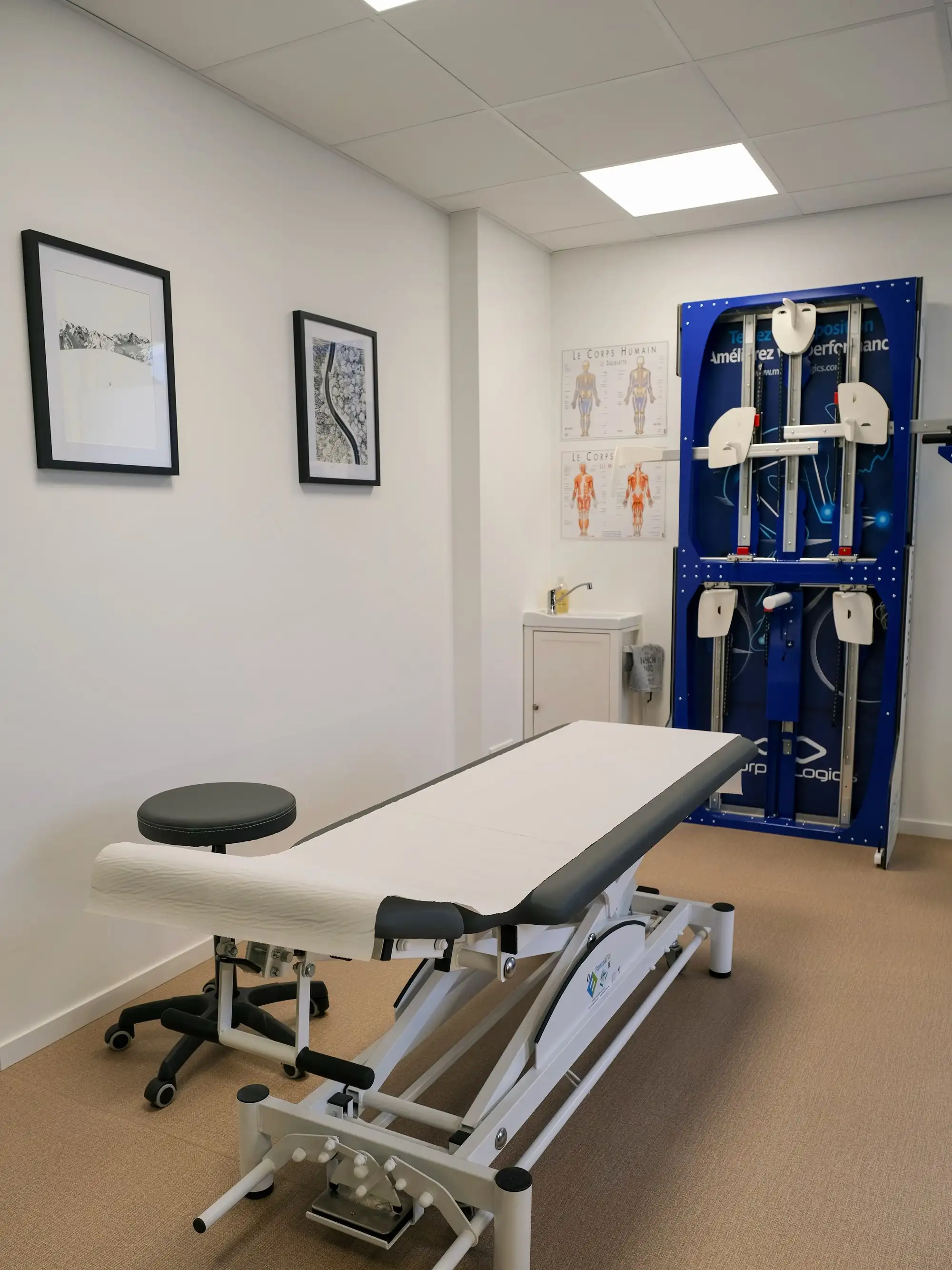
Cleat setup €40, included in the full bike fit. In Viviers-du-Lac, between Aix-les-Bains and Chambéry.