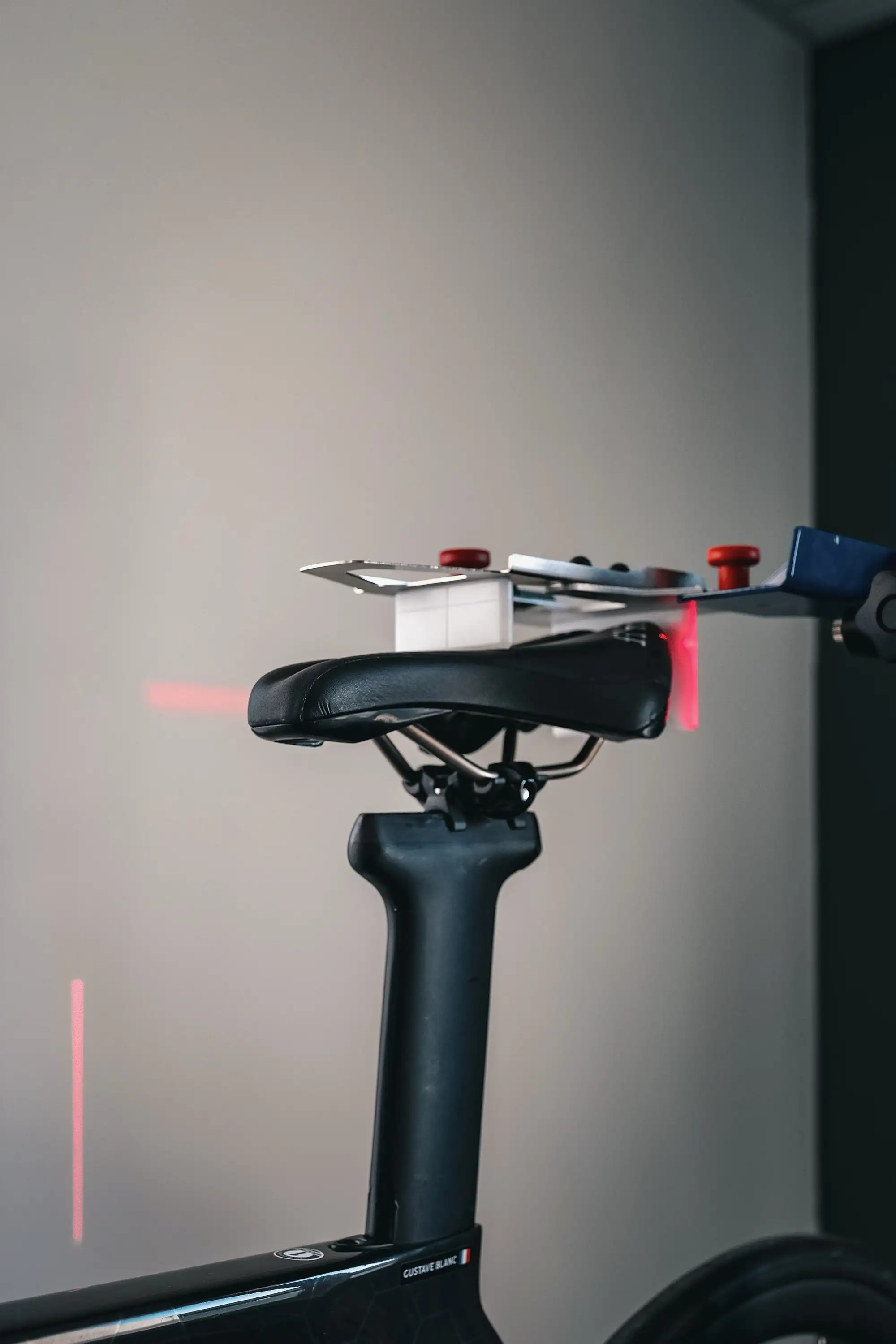
Saddle height: the calculation, and what the calculation cannot see
The setting that matters most on a bike. The calculator gives you a starting value, the chart places your inseam, and the rest explains why two riders of the same height do not ride at the same saddle height.
By Gaspard Blanc, osteopath (D.O.) and bike fitter · Updated 25 October 2026
Saddle height calculator
LeMond method: inseam × 0.883, measured from the centre of the bottom bracket axis to the top of the saddle, corrected for crank length. It is the same calculation as in the FramIQ app, so both give the same value.
724 mm
Measured along the seat tube.- LeMond raw × 0.883
- 724 mm
- Crank correction
- ± 0 mm
- Target knee angle at the bottom of the stroke
- 141° – 152°
- Recommended adjustment step
- 3 mm
A starting point, not a final verdict: the height is validated by the knee angle at the bottom of the stroke, between 141 and 152 degrees, and by how you feel after two or three rides.
Measuring your inseam properly
The accuracy of the calculation depends on the accuracy of the measurement: a 10 mm error on the inseam gives a 9 mm error on the saddle.
- PositionBarefoot, back and heels against a wall, feet hip-width apart.
- The bookA hard book between your legs, level, pulled firmly up against the perineum, as if sitting on a saddle.
- The measurementFrom the floor to the top edge of the book, with a tape measure. Do it twice and keep the average.
- The height on the bikeFrom the centre of the bottom bracket axis to the top of the saddle, at its middle, with the tape along the seat tube.
Chart by inseam and height
Height is indicative: the inseam averages 46% of height, but two people of the same height can differ by 5 cm. Measure, do not guess.
| Inseam | Indicative height | Crank 165 | 170 | 172.5 | 175 |
|---|---|---|---|---|---|
| 700 mm | ≈ 150 to 154 cm | 623 | 618 | 615 | 613 |
| 710 mm | ≈ 152 to 156 cm | 632 | 627 | 624 | 622 |
| 720 mm | ≈ 155 to 159 cm | 641 | 636 | 633 | 631 |
| 730 mm | ≈ 157 to 161 cm | 650 | 645 | 642 | 640 |
| 740 mm | ≈ 159 to 163 cm | 658 | 653 | 650 | 648 |
| 750 mm | ≈ 161 to 165 cm | 667 | 662 | 659 | 657 |
| 760 mm | ≈ 163 to 167 cm | 676 | 671 | 668 | 666 |
| 770 mm | ≈ 165 to 169 cm | 685 | 680 | 677 | 675 |
| 780 mm | ≈ 168 to 172 cm | 694 | 689 | 686 | 684 |
| 790 mm | ≈ 170 to 174 cm | 703 | 698 | 695 | 693 |
| 800 mm | ≈ 172 to 176 cm | 711 | 706 | 703 | 701 |
| 810 mm | ≈ 174 to 178 cm | 720 | 715 | 712 | 710 |
| 820 mm | ≈ 176 to 180 cm | 729 | 724 | 721 | 719 |
| 830 mm | ≈ 178 to 182 cm | 738 | 733 | 730 | 728 |
| 840 mm | ≈ 181 to 185 cm | 747 | 742 | 739 | 737 |
| 850 mm | ≈ 183 to 187 cm | 756 | 751 | 748 | 746 |
| 860 mm | ≈ 185 to 189 cm | 764 | 759 | 756 | 754 |
| 870 mm | ≈ 187 to 191 cm | 773 | 768 | 765 | 763 |
| 880 mm | ≈ 189 to 193 cm | 782 | 777 | 774 | 772 |
| 890 mm | ≈ 191 to 195 cm | 791 | 786 | 783 | 781 |
| 900 mm | ≈ 194 to 198 cm | 800 | 795 | 792 | 790 |
| 910 mm | ≈ 196 to 200 cm | 809 | 804 | 801 | 799 |
| 920 mm | ≈ 198 to 202 cm | 817 | 812 | 809 | 807 |
| 930 mm | ≈ 200 to 204 cm | 826 | 821 | 818 | 816 |
| 940 mm | ≈ 202 to 206 cm | 835 | 830 | 827 | 825 |
| 950 mm | ≈ 205 to 209 cm | 844 | 839 | 836 | 834 |
Values in mm, from the bottom bracket axis to the top of the saddle.
Two riders with the same inseam, two saddle heights
The formula measures a bone, not a rider. At the practice, over more than 350 bike fits, the final height differs from the calculation by 5 to 15 mm in one case out of three. The reasons are always the same:
- The ankle. A flexible ankle drops the heel at the bottom of the stroke and lengthens the usable leg: the saddle goes up. A stiff ankle, or a foot that pedals toes down, does the opposite.
- The hip. If hip flexion is limited, the pelvis tips backwards to reach the handlebar, and the calculated saddle suddenly becomes too high. It is the most common cause of low back pain on the bike, and it is treated before adjusting.
- Foot length and shoe thickness. A size 44 foot with a thick sole has nothing in common with a size 40 and a thin sole, for the same inseam.
- One leg shorter than the other. More common than you think. Setting the saddle for the long leg hurts the short one, and the other way round. The answer is not always a shim: sometimes a shorter crank on one side, as in this case seen at the practice.
- The discipline. A high-cadence rider, a climber, a triathlete on aerobars and a mountain biker do not need the same height.
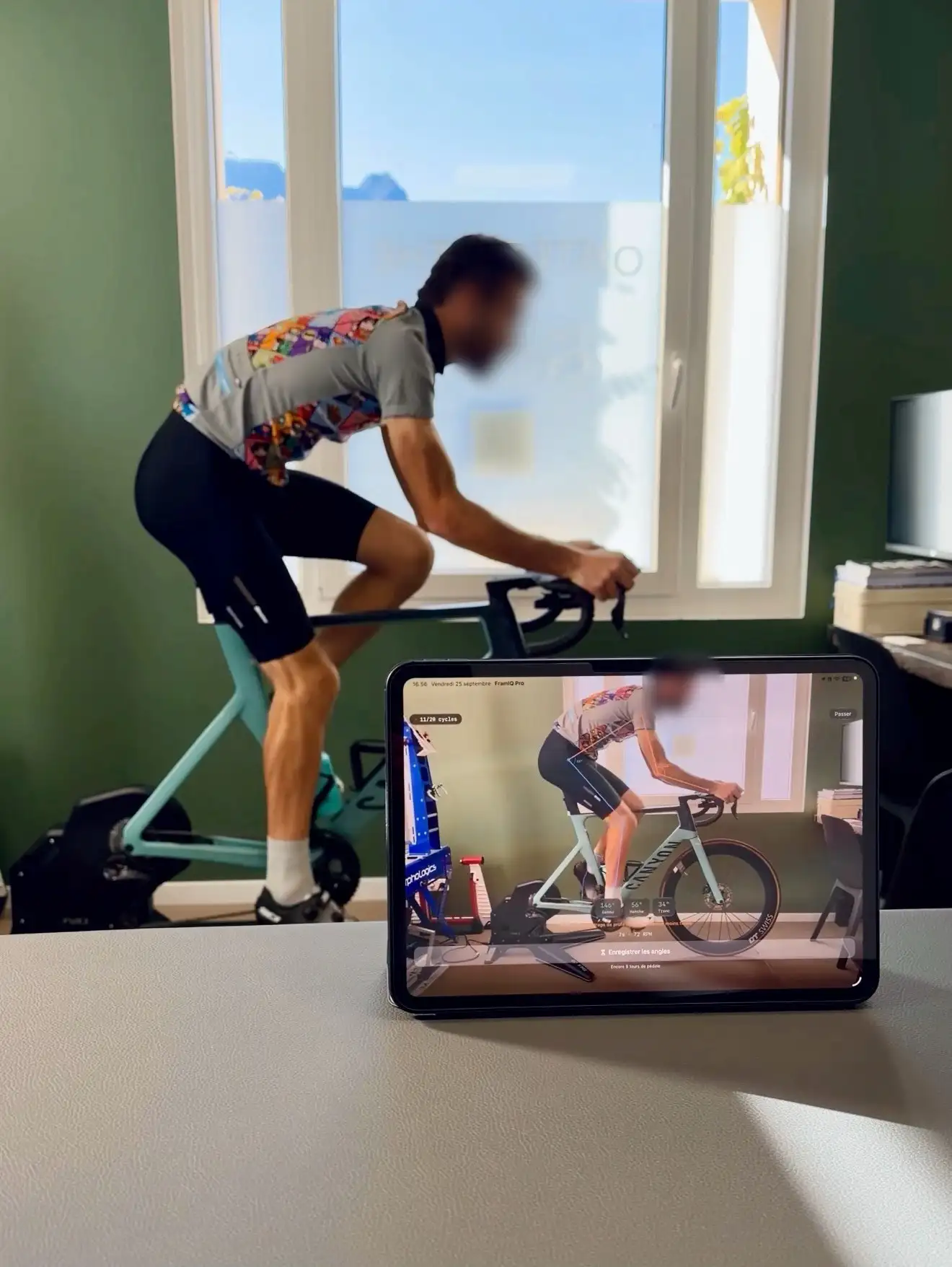
That is why I never set a saddle by the formula. I measure, I examine hip and ankle mobility off the bike, then I adjust on the indoor trainer while watching the knee angle on video, and the pelvis: if it moves, the saddle is too high, whatever the calculation says.
Saddle too high or too low: the signs
| What you feel | Likely cause | What I would do |
|---|---|---|
| Pain behind the knee, tight hamstrings | Saddle too high or too far back | Lower by 3 mm, check the setback |
| Pelvis rocking with every pedal stroke, chafing | Saddle too high | Lower by 3 to 5 mm |
| Pain at the front of the knee or under the kneecap | Saddle too low or too far forward | Raise by 3 mm, check the setback |
| Thighs burning early, knees coming up high | Saddle too low | Raise by 3 to 5 mm |
| Toes pointing down at the bottom of the stroke | Saddle too high, or a very mobile ankle | Lower by 3 mm, look at the ankle on video |
| Pain on one side only, chafing on one side of the saddle | Shorter leg, asymmetric pelvis | Do not guess: examination of the pelvis and leg lengths |
| Numb perineum | Saddle too high or tilted nose up | Level the saddle, lower by 3 mm |
Pain that persists after two careful adjustments is no longer a height problem: it is time to have the body examined, not to move the saddle a third time. See also knee pain when cycling and saddle pain.
Validate the height, then the rest
Saddle height is only one of the settings. Saddle setback, cleat position, handlebar height and reach are adjusted in a precise order, and each one changes the others.
To validate your knee angle at home, the FramIQ app films your pedalling and measures the angles. To see it through, the full bike fit is the only service that includes video analysis on the indoor trainer: there we validate the saddle height to the degree, then the setback, the cleats and the handlebar, after examining your mobility. That is where the calculation becomes a position that lasts.
Saddle height: your questions
How do I calculate my saddle height?
Measure your inseam barefoot, a book pressed firmly against the perineum, from the floor to the top edge of the book. Multiply by 0.883: that is the distance from the bottom bracket axis to the top of the saddle, along the seat tube, for 170 mm cranks. Take off 2.5 mm for every 2.5 mm of extra crank length, add it back for a shorter crank.
Is the 0.883 formula reliable?
It is a good starting point for eight riders out of ten, within 5 to 10 mm. It ignores your foot length, the flexibility of your ankles and hips, and the thickness of your shoes and saddle. The final value is validated by the knee angle at the bottom of the stroke, between 141 and 152 degrees, and by the absence of pain after a few rides.
What are the signs of a saddle that is too high or too low?
Too high: pelvis rocking from side to side, pain behind the knee or in the hamstrings, chafing and numbness on the saddle, toes pointing down. Too low: pain at the front of the knee or under the kneecap, thighs burning early, a feeling of pedalling “in a hole”, knees coming up high.
How much should I move the saddle at a time?
By 3 mm, then two or three rides before judging. A 10 mm change in one go is felt everywhere and stops you knowing what helped.
Is saddle height the same for road, gravel and MTB?
The starting height is calculated the same way. On MTB and gravel you often come down 5 to 10 mm for handling and impacts, and a dropper post settles the question on descents. On a time trial bike the saddle moves forward and slightly up.
The calculation gave you a number. Video and the body have the final say.
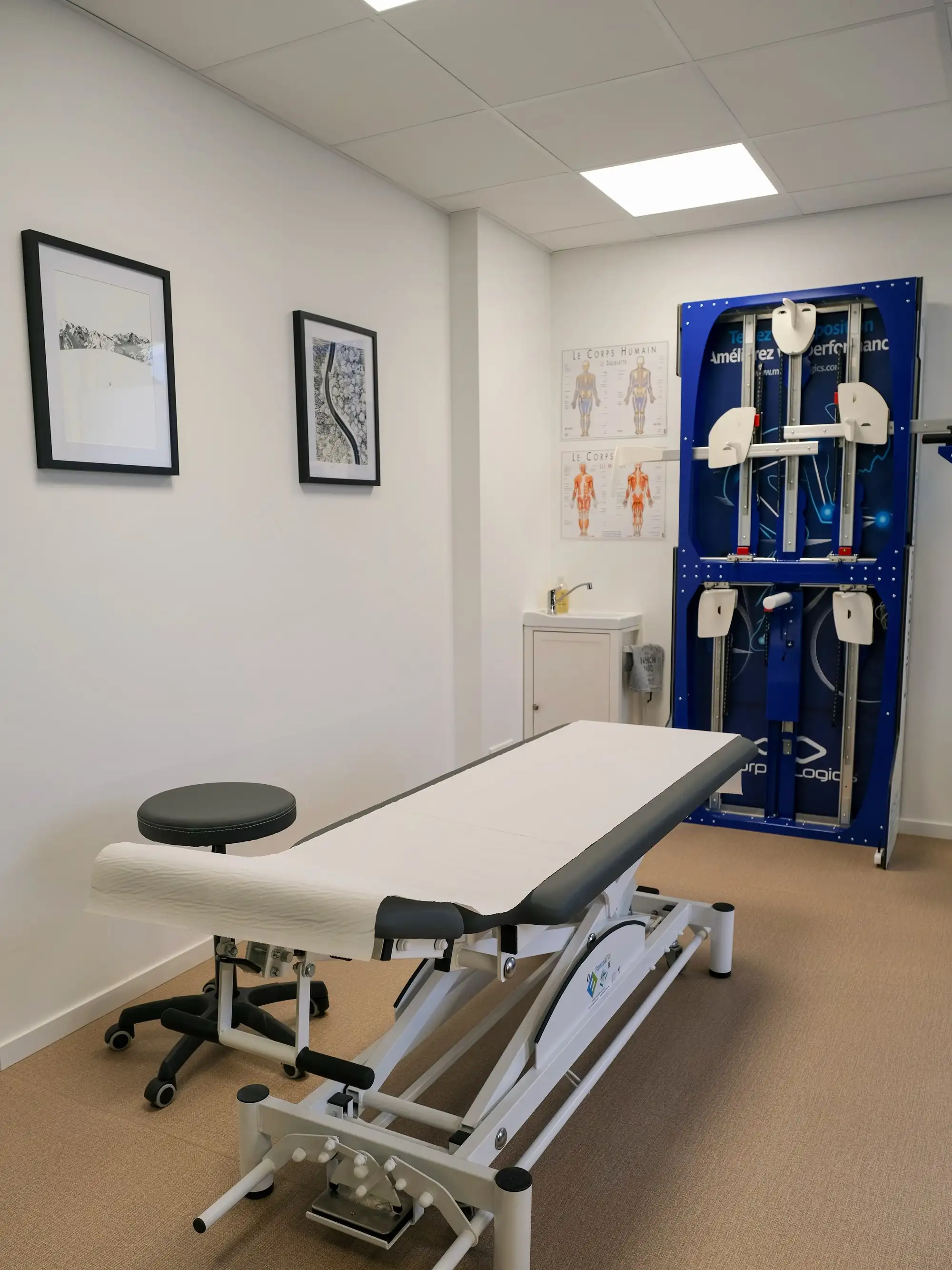
Full bike fit: osteopathic examination, Morphologics measurements, video analysis on the indoor trainer, adjustments included for three months. In Viviers-du-Lac, between Aix-les-Bains and Chambéry.