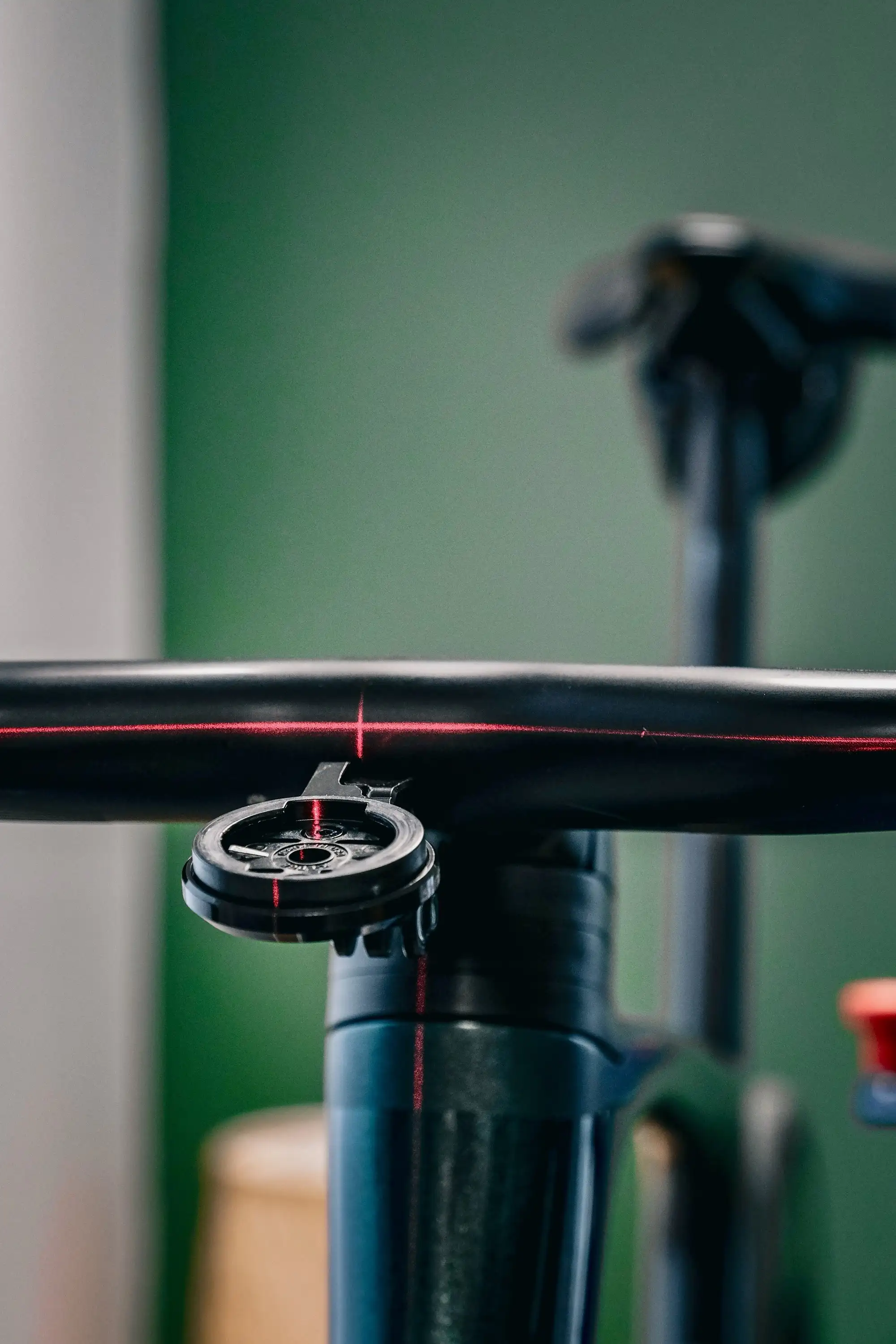
Handlebar width: your shoulders, your discipline, and what the studies say
"A handlebar as wide as your shoulders": the rule is fifty years old, nobody knows where it came from, and the pros at the Tour ride 2 to 4 cm narrower. Here is what measurements and published studies actually allow us to say, discipline by discipline.
By Gaspard Blanc, osteopath D.O. and bike fitter · 25 October 2026 · Studies cited at the end
In brief
- Starting point on the road: your shoulder width, acromion to acromion, measured centre to centre at the hoods. Pros ride 2 to 4 cm narrower.
- A narrower bar saves about 2 W per centimetre at 45 km/h, four times less at 30 km/h, and not for everyone.
- Within ± 4 cm of shoulder width, no study shows an effect on breathing or comfort; on aero extensions, narrow elbows cost breathing effort.
- MTB: 760 to 800 mm, shoulder width is irrelevant; gravel: read three numbers, hoods, drops, flare.
- The UCI 2026 400 mm rule only applies to UCI competitions.
Handlebar width decides where your elbows go, therefore your shoulders, therefore your neck. Too wide, the shoulders rise and the upper traps work for nothing. Too narrow, the elbows tuck in, the steering gets twitchy and, on aero extensions, the ribcage closes up. Between the two there is a fairly broad range where the body adapts without complaint, and it is within that range that aerodynamics and control make the difference.
This guide gives a starting point for each discipline, a reliable measuring method, and above all what the published studies do and do not allow us to claim. Because when it comes to handlebars, a lot of figures circulate without a source, and I preferred to keep only those I can show you.
Measuring your shoulder width
The reference used by anthropometrists is biacromial breadth: the distance between the two acromions, the bony points at the top of the shoulders, just beyond the joint with the collarbone. It is the measurement used by the big public health surveys, and the one I take at the practice.
- The positionStanding, feet hip-width apart, arms hanging and relaxed, eyes level. Do not "open" the chest or pull the shoulders in.
- The landmarkA second person runs a finger down from the neck towards the shoulder and stops at the outer edge of the flat bone on top: that is the acromion. A pencil mark on each side.
- The measurementStraight-line distance between the two marks, with a rigid ruler or two set squares placed against the landmarks and a tape stretched between them. A soft tape that follows the curve of the back overestimates by 1 to 3 cm.
- The checkThree measurements, keep the median. More than 5 mm between two attempts means a landmark is badly placed.
To put your result in context: according to the American reference data, an adult man measures on average 41 cm acromion to acromion, a woman 37 cm, with roughly 4 cm either side between the 5th and 95th percentile. In other words, the "shoulders equal handlebar" rule gives 36 to 38 cm for most women and 40 to 42 cm for most men. Handlebars on the market start at 36 cm, which leaves some women without a handlebar at their width.
A starting point for each discipline
Shoulder width is the starting point in road and gravel. On a mountain bike and on aero extensions, other criteria take over.
| Discipline | Starting point | Common range | What matters most | Regulations |
|---|---|---|---|---|
| Road | Shoulder width, centre to centre at the hoods | 36 to 44 cm | Shoulder and neck comfort, aero at high speed | UCI 2026: 400 mm outside to outside, in UCI competition only |
| Gravel | Shoulders + 0 to 2 cm at the hoods, 12 to 16° flare | 40 to 46 cm at the hoods, 44 to 52 cm at the drops | Control on descents, room for the knees, the position you use most | Flare limited to 65 mm per side in UCI events |
| MTB | 760 to 780 mm to start, then trial | 740 to 800 mm | Bike geometry, riding style, shoulders that do not hunch | No rule |
| Triathlon and time trial | Elbows under the shoulders or slightly inside, to be tested | 10 to 20 cm between the centres of the arm pads | Trade-off between breathing and drag, specific to each rider | UCI: length and height by rider height, no pad width imposed |
Watch the conventions: manufacturers measure sometimes centre to centre, sometimes outside to outside, sometimes at the hoods, sometimes at the drops. A road handlebar with a 23.8 mm tube measures about 2.4 cm more outside to outside than centre to centre.
On the road: shoulders, aero and the UCI 2026 rule
This is the discipline where shoulder width is most useful, and where it is most contested. The challenge comes from aerodynamics. The rider's body accounts for about 80% of total drag, and bringing the arms closer reduces frontal area. The most solid published figure is AeroCoach's, quoted by BikeRadar: about 2 W per centimetre removed at 45 km/h, so 7 to 8 W going from 42 to 38 cm, and only 0.5 W per centimetre at 30 km/h. Drag grows with the cube of speed: at sportive speed, the gain is three to four times smaller than at peloton speed.
And this gain is not universal. In AiRO's simulation on eight rider profiles and four widths, one profile gains nearly 12 W at 45 km/h between 42 and 36 cm, but a large rider sees his drag increase when moving to 38 cm, and a female sprinter gains nothing. Cervélo's wind tunnel tests on three professional riders tell the same story: bringing the elbows in reduces drag in three tests out of four, and increases it in the fourth. What happens between the arms, the hips and the thighs depends on body shape, and there is no "watts per centimetre" that holds for everyone.
What the body says
On the physiology side, the data is more reassuring than people think. A 2023 study on 24 active adults found no difference in oxygen uptake, ventilation, spirometry or comfort between a handlebar at shoulder width, 4 cm narrower and 4 cm wider, at moderate intensity. Within that range, breathing does not settle the question. A 2025 study on ten women at 100 W adds the muscular piece: the handlebar equal to shoulder width minimises the activity of the biceps and the latissimus dorsi; narrower, the biceps works a third harder; wider, it is the latissimus dorsi. Pedalling efficiency, for its part, does not move. Finally, the 2014 Norwegian wind tunnel trial on six elite riders sums up the trade-off: narrowing the handlebar reduces frontal area without affecting power, but the position is rated less comfortable.
My reading as an osteopath: the comfort range is wide, around ± 4 cm, and within that range it is your usual speed and your shoulders that decide. Below 35 km/h average, a handlebar at shoulder width, or 2 cm narrower, is almost always the right choice. Above that, and in competition, 2 to 4 cm narrower at the hoods with flared drops for sprinting and descending, exactly what the pros do: at the 2023 Tour, the most common widths were 36 and 38 cm for men whose shoulders measure around 40 cm.
The UCI rule for 2026
Since 1 January 2026, in UCI road and cyclo-cross mass-start events, the handlebar must measure at least 400 mm outside to outside, with a maximum flare of 65 mm per side and at least 280 mm between the inside of the hoods, this last value to be reviewed within the year. On the track, it will be 350 mm from 2027. Inward tilt of the levers has been limited to 10° since January 2024. The UCI cites safety and, in its September 2025 press release, the intention to contain speeds through drag. The criticism concerns women and smaller riders: an audit quoted by Escape Collective counted 84% of WorldTour bikes non-compliant with the first version of the text, and some of the women riders were on 36 cm. For you, the conclusion is simple: if you do not race UCI events, this rule does not apply to you.
Road handlebar width by shoulder width
Widths centre to centre, measured at the hoods, in cm. Flared handlebars let you be narrow at the hoods and wider at the drops.
| Shoulder width | Endurance, touring | Sporty, sportives | Racing, aero focus |
|---|---|---|---|
| 34 to 36 cm | 36 to 38 cm | 36 cm | 34 to 36 cm |
| 36 to 38 cm | 38 to 40 cm | 36 to 38 cm | 34 to 36 cm |
| 38 to 40 cm | 40 cm | 38 to 40 cm | 36 to 38 cm |
| 40 to 42 cm | 42 cm | 40 cm | 38 cm |
| 42 to 44 cm | 44 cm | 42 cm | 40 cm |
| 44 to 46 cm | 44 to 46 cm | 44 cm | 42 cm |
Widths below 36 cm barely exist on the market: below that, you work with hoods turned slightly inwards, within the 10° limit if you race, and with a flared handlebar. These reference points are my own, cross-checked with the studies cited; they do not replace a trial on the indoor trainer with the handlebar in your hands.
Gravel: three widths on the same handlebar
A gravel handlebar is read with three numbers: the width at the hoods, the width at the drops, and the flare angle between the two. Flare only widens the drops; the hoods remain the position you use most, so the shoulder comfort reference stays the same as on the road, at shoulder width or 1 to 2 cm above for stability on rough tracks. At the drops, flare adds 1 to 6 cm depending on the model: more leverage on descents, more room between the forearms and the knees, and a little less aero.
The consensus among specialist guides is 12 to 16° for mixed use, 20° and more for committed off-road riding. I should point out that this is a consensus of manufacturers and media: no published study measures the effect of flare on control, the wrist or the shoulder. A "42" handlebar with 16° of flare can measure 46 to 48 cm at the drops, and that is often where the hands go on descents. If you race UCI gravel events, flare is limited to 65 mm per side.
One thing I check on every gravel bike fit: some flared handlebars also angle the hoods outwards, and the wrist ends up in deviation. If your hands go numb on gravel and not on the road, that is often the cause, not the width. The other causes, and the signs that should send you to a doctor, are covered in the article on numb hands on the bike.
Mountain bike: 760 to 800 mm, and shoulders that must not rise
On a mountain bike, shoulder width is of almost no use. Handlebars measure nearly twice the biacromial breadth, and it is the bike geometry, riding style and terrain that decide. The consensus among specialist media, backed by their testers' own measurements, puts the trail and enduro range between 760 and 800 mm, with 760 to 780 mm as the starting point for most body sizes; riders of 1.70 m ride 775 mm, champions of 1.80 m ride 740. It has to be said plainly: there is no published study on handlebar width in mountain biking, nor on steering torque, nor on injuries. Everything that follows is clinical observation.
What I observe, and what the physiotherapists quoted by the American guides also describe: a handlebar that is too wide spreads the elbows, makes the shoulders rise and puts the arm into internal rotation. That is the position that irritates the rotator cuff and the front of the shoulder, and it is the most frequent complaint of mountain bikers who come to see me after switching from a 740 to an 800 "because everyone rides wide". An EMG test run by a physiotherapist on one rider shows the upper trapezius switching on as soon as the elbows go beyond a certain width, well below that of his handlebar. One case, not a study, but it matches what I see on the table.
The method, in the absence of a formula: start at 760 to 780 mm, ride for a few weeks, and only ever cut 5 mm per side. The margin between "not confident" and "confident" is about fifteen millimetres. And the acromioclavicular dislocations sometimes blamed on wide handlebars come from falls onto the shoulder, not from the width itself.
Aero extensions: elbow width is paid for in breathing
On aero extensions, the question is no longer the width of the handlebar but that of the arm pads, and it is the only setup where the science documents a breathing cost. The study by Charlton and colleagues, published in 2017, measured the work of breathing in eleven trained cyclists on aero extensions versus hoods and drops: it rises clearly on the extensions, as does diaphragm pressure, and the rise is greater the closer the elbows are relative to the shoulders. The correlation is strong. Older work on elite riders already showed higher oxygen uptake and heart rate on aero extensions, with the conclusion that the aero gain is well worth that extra cost.
On the other side, Cervélo's wind tunnel tests give about 50 g less drag per centimetre of elbow narrowing at 48 km/h, for three riders out of four, and a penalty for the fourth. The "elbows together" positions of the 2020s chase that gain; the regulations, for their part, govern the length and height of the extensions according to rider height, never the width of the pads. Neither the UCI nor World Triathlon imposes a minimum spacing.
My practice: I start with the elbows under the shoulders or slightly inside, then narrow in one-centimetre steps on the indoor trainer, watching three things: breathing rate at constant power, how well the position holds beyond twenty minutes, and the neck. The right spacing is the one you can hold over the full distance of your event, not the one that is fastest for five minutes.
Too wide, too narrow, or badly adjusted
| What you feel | Likely cause | What I would do |
|---|---|---|
| Burning upper traps, shoulders raised towards the ears | Handlebar too wide, or too far away | Check the reach, then go down one width |
| Locked elbows, straight arms, hands going numb | Handlebar too far away or too low, sometimes too narrow | Bring it closer before going wider |
| Feeling of suffocation in the drops | Handlebar too low rather than too narrow | Raise it, then only test the width |
| Twitchy steering, bike unstable on descents | Handlebar too narrow, reduced leverage | One width up, or flared drops |
| Knees hitting the elbows out of the saddle | Handlebar too narrow for your build | Go wider at the hoods or at the drops |
| Pain in one shoulder only, one wrist only | Asymmetry of the torso or arms, not the width | Examination before changing the handlebar |
What I look at before talking about width
Width is the last variable I touch on a handlebar. Before it come reach and height, which explain most neck, upper-trap and hand pain, and the rotation of the hoods, which decides the wrist angle. On the indoor trainer, I check on video whether the shoulders stay low, whether the elbows keep a little bend and whether the head is held without effort. Then I measure your acromions and compare with the handlebar fitted. When everything else is right and the shoulders stay hunched or the elbows locked, we change width, and we check again.
From your measurements, the FramIQ app gives you a starting point for the handlebar as well as the rest of the cockpit. Beyond that, the full bike fit goes over everything, shoulder measurement, reach, height and hood rotation included. And if a shoulder or a wrist hurts on one side only, the osteopathic examination comes before any change of handlebar.
Handlebar width: your questions
How do I measure my shoulder width for a handlebar?
Standing, arms relaxed, someone finds the bony point at the top of each shoulder, the acromion, and measures the straight-line distance between the two with a rigid ruler. Three measurements, keep the median. A soft tape that follows the back overestimates by 1 to 3 cm. The result is the starting point for a road handlebar measured centre to centre.
Does a narrower handlebar really save watts?
Yes at high speed, little at sportive speed. The most widely quoted figure, from AeroCoach, is about 2 W per centimetre removed at 45 km/h and 0.5 W per centimetre at 30 km/h. And the gain is not universal: in simulation, two riders out of eight gain nothing or lose, depending on the shape of their hips and thighs.
Does a narrow handlebar restrict breathing?
Not within the range studied. A study on 24 adults found no difference in ventilation, oxygen uptake or comfort between a handlebar at shoulder width, 4 cm narrower and 4 cm wider. The documented breathing cost concerns the position on aero extensions, and it increases as the elbows come in relative to the shoulders.
Which handlebar width for mountain biking?
The consensus sits between 760 and 800 mm for trail and enduro, with 760 to 780 mm as the starting point for most body sizes. Shoulder width is of little use: the bike geometry, riding style and any shoulder complaints decide. You adjust by trial, 5 to 10 mm per side, never more at once.
Does the UCI 400 mm rule apply to me?
Only if you race UCI road or cyclo-cross events. Since 1 January 2026, the handlebar there must measure 400 mm outside to outside, with at least 280 mm between the hoods and a maximum flare of 65 mm per side. For a sportive rider or a leisure cyclist, this rule carries no weight: only your shoulders, your neck and your hands count.
Should I change the handlebar or the setup?
The setup first. A good share of neck, upper-trap and hand pain comes from a handlebar that is too far away or too low, not from its width. When the height and reach are right and the shoulders stay hunched or the elbows locked, width becomes the main suspect.
Studies and sources cited
The studies and official documents this article relies on, in order of robustness. The figures from AeroCoach, AiRO and Cervélo are manufacturer or simulation data, not peer-reviewed publications, and are presented as such.
- McDowell M.A., Fryar C.D., Ogden C.L., "Anthropometric Reference Data for Children and Adults: United States, 1988-1994", Vital and Health Statistics 11(249), CDC, 2009
- Charlton J.M. et al., "Respiratory mechanical and cardiorespiratory consequences of cycling with aerobars", Medicine & Science in Sports & Exercise 49(12), 2017
- Lin Z.-J., Tsai P.-C., Chen C.-H., "Handlebar Width Choices Must Be Considered for Female Cyclists", Journal of Functional Morphology and Kinesiology 10(1):28, 2025
- Fahey M.J., Cannon D.T., "Bicycle Handlebar Width Does Not Affect Spirometry, Ventilation, or Gas Exchange", International Journal of Exercise Science, Conference Proceedings 14(3):132, 2023
- Gnehm P. et al., "Influence of different racing positions on metabolic cost in elite cyclists", Medicine & Science in Sports & Exercise 29:818-823, 1997
- Oggiano L., Sætran L., Bardal L.M., "Individual Performance Optimization of Elite Cyclists", icSPORTS 2014, NTNU
- UCI, "UCI statement on its recent decisions regarding changes to equipment regulations based on SafeR recommendations", June 2025
- UCI, Kigali Management Committee press release, equipment measures for 2026 and 2027, September 2025
- UCI, "UCI Regulations for road cycling: changes for time trials", 2023 rules
- Escape Collective, R. Mc Laughlin, "UCI confirms handlebar rules and bans some aero helmets", September 2025
- Escape Collective, R. Mc Laughlin, "UCI starts lever angle checks at TDU opener", January 2024
- BikeRadar, S. von Bromley, "How narrow is too narrow?", AeroCoach data (Dr X. Disley), 2021
- BikeRadar, S. von Bromley, "Life behind bars: aero is everything for cockpits at the 2023 Tour de France", 2023
- AiRO, P. Facomprez, "Narrower handlebars on road bikes, part 1", CFD simulation, 8 riders and 4 widths
- mbr, B. Haworth, "760mm to 800mm is the mbr spectrum", 2018
Literature search carried out on 25 October 2026. UCI regulations are cited from the official press releases; the consolidated text may change during the season.
Hunched shoulders, tight upper traps, numb hands? A handlebar is set up, not guessed.
Full bike fit with shoulder measurement, video analysis on the indoor trainer and cockpit setup. In Viviers-du-Lac, between Aix-les-Bains and Chambéry.